



.jpg?width=1000&height=667&name=shutterstock_2012695325%20(1).jpg)

07.28.2026 Suzanne Worthington
First published 13 November 2024 | Tom Owens
Updated 2 July 2026 | Suzanne Worthington
Working out how many care staff you need per resident is one of the toughest calls you make as a care home manager. You want to keep people safe, meet regulatory expectations and still give your team enough time to deliver truly person-centred care.
But here’s the reality: there’s no fixed staff-to-resident ratio you can rely on. Instead, you need to balance resident needs, staff skills and the day-to-day reality of your home. In this guide, we look at what truly matters and how you can set safe, effective staffing levels with confidence.
In this post
There's no magic formula for care home staffing
Regulations about safe staffing
How the right level of staffing benefits everyone in your care home
Traditional ratio models no longer work
Factors that influence how many care staff you need per resident
How to plan staffing with confidence (not guesswork)
There's no magic formula for care home staffing
Safe staffing levels can’t be quantified in a one-size-fits-all formula. Even though traditional models exist, it’s not ideal to just decide that you should have a ratio of 1:5 or 1:10 and stick to that no matter what variables exist. If you stick to rigid formulas for staffing, as many care homes have done in the past, then you won't be maximising the energy and time of your staff and you could end up under- or over-staffed, or with staff facing burnout or poor work-life balance.
If you're a manager, it’s your responsibility to understand the factors that contribute to safe staffing levels and then make educated assumptions about what's required and when, and in what mix. And of course, you'll need to be ready to adapt as this changes over time.
A smart way to get ahead in this type of decision-making is to remove any decision that isn’t judgement and experienced based out of the equation. For example, using a digital tool for staff dependency that helps you allocate staff in the right places and with the right mix to make sure staffing levels reach the desired threshold for high standards of care and compliance.
Regulations about safe staffing
The main regulatory bodies in the UK including England, Wales and Scotland, do not state a precise number on what constitutes safe staffing. Instead, they outline things to consider to make sure that you achieve safe staffing levels.
When you’re thinking about safe staffing levels at your home, here's what the regulators say:
Regulation 18(1) in England for the CQC
'Sufficient numbers of suitably qualified, competent, skilled and experienced persons must be deployed in order to meet the requirements of this Part.'
Regulation 34 in Wales for the CIW
'The service provider must ensure that at all times a sufficient number of suitably qualified, trained, skilled competent and experienced staff are deployed to work at the service.'
Health and Care (Staffing) (Scotland) Act 2019 for the CI
'Any person who provides a care service must ensure that at all times suitably qualified and competent individuals are working in the care service in such numbers as are appropriate for:
(a) the health, wellbeing and safety of service users
(b) the provision of safe and high-quality care, and
(c) in so far as it affects either of those matters, the wellbeing of staff.'
How the right level of staffing benefits everyone in your care home
Getting staffing levels right is the foundation of good person-centred care. When you don’t have enough people on shift, everything else starts to slip, no matter how committed your team is.
Even the best staff can’t deliver the level of care they want to if don't have the time and capacity to do the job properly.
What good staffing looks like in practice
When your staffing levels are right and you have the right mix of skills, the basics of care are done well, consistently. Personal care is delivered to a high standard, and your team can respond quickly when something unexpected happens.
Plus there’s more capacity to handle the day-to-day realities of running a home, like keeping records up to date and staying in touch with families and health professionals. These things often get squeezed when staffing is tight, but they’re essential to safe, joined-up care.
Making time for more than just tasks
Good care isn’t just about getting through a list of tasks. Your team needs time and headspace to connect with residents too. That might be chatting over cups of tea, running meaningful activities or planning something special that lifts someone’s mood. These moments don’t happen when staff are rushing from one job to the next - they need breathing room.
When staffing levels are right, your team can support residents’ emotional and social wellbeing, not just their physical and clinical needs.
Why staffing levels matter for your team too
Your residents aren’t the only ones affected by staffing levels - your team feels it too. If there aren’t enough people on shift, workloads increase and pressure builds. Over time, that leads to stress, burnout and lower job satisfaction. And when staff feel like they can’t do their job properly, they’re more likely to leave.
With the right level of staffing, you protect your team’s wellbeing, improve retention and create a more stable, consistent service.
Traditional ratio models no longer work
Traditionally, it was often health authorities that determined staffing levels in nursing homes and local authorities did likewise for residential care. These levels were often based on pre-set ratios of 1 carer to 5 residents in the morning, 1 to 8 in the afternoon and 1 to 10 at night.
But things have changed. Studies have consistently shown that dependency in care homes has risen sharply in the past two decades. In a 2026 report on care home development, real estate company Savills noted:
'The market has increasingly shifted towards serving residents with higher acuity needs, as access to care homes has tightened and lower-dependency cohorts are more often supported in community settings.' [source]
And in a speech at the Nuffield Trust Summit in March 2026, Baroness Casey stated:
'...staring us in the face is the fact that the number of older people has increased more rapidly han the number working age people. This means more people to care for, with fewer people to care for them.' [source]
With increasingly complex, challenging and demanding care needs, the traditional staffing ratios are now inadequate as a foundation for person-centred care.
Factors that influence how many care staff you need per resident
One of the main reasons the traditional ratio models (see above) are flawed is that they don’t take into account some of the main factors that should influence decisions on safe staffing levels. For example, resident dependency has a significant effect on your staffing decisions, and dependency can change quickly.
A static ratio can't account for the evolving needs of your residents, or for conditions such as cognitive disorders that require more specialised staff.
There are other factors which a static ratio can't account for, such as the layout of a care home. For example, if your care home is a renovated old manor house, moving to and from rooms might take much longer than for staff in a purpose-built care home housing.
How to plan staffing with confidence (not guesswork)
Because every home is different, there’s no single number or ratio that defines safe staffing. But that doesn’t mean you have to rely on guesswork. Your experience matters, but it works best when it’s backed up by clear, reliable data.
With the right insight, you can plan staffing levels to match your residents’ needs, get the right mix of skills on shift and avoid the knock-on effects of being under or overstaffed.
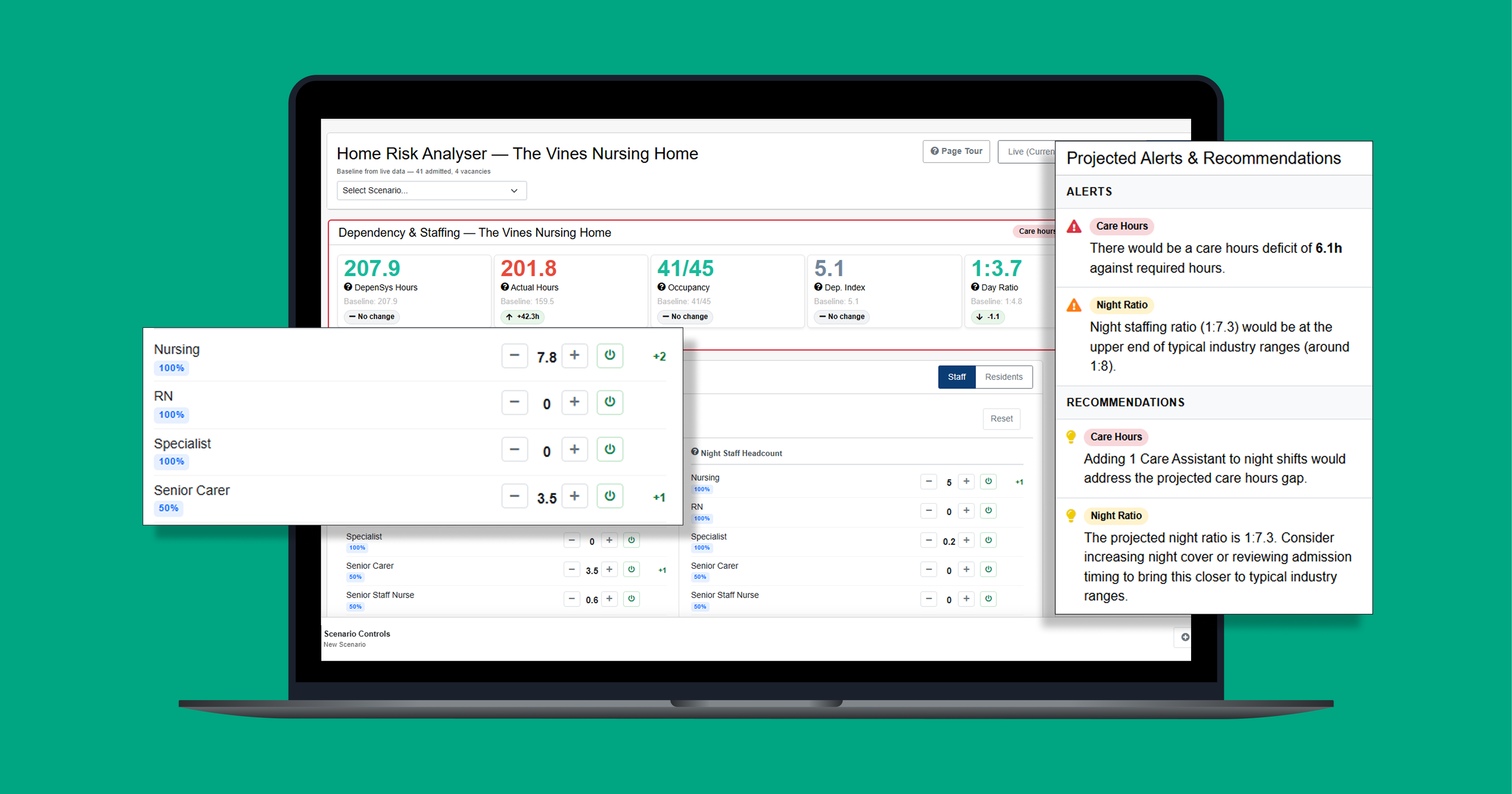
That’s exactly where our Staffing and Dependency tool can help. The tool uses uses the care data you’re already recording about your residents and turns it into clear, practical staffing recommendations. This allows you to make confident decisions backed up by data, using your team’s time well and supporting both staff wellbeing and quality of care.
To see what this looks like in practice, read the case study:
👉 How Royal Star & Garter use the PCS Staffing and Dependency tool to take a more data-driven approach to staffing
Sources
Savills | UK Care Home Development Report, 1 July 2026 | Accessed 2 July 2026
Casey Commission | Baroness Casey calls for a moment of reckoning on adult social care, 5 March 2026 | Accessed 2 July 2026
Baroness Casey’s speech to the Nuffield Trust Summit, 5 March 2026 | PDF | Accessed 2 July 2026
Free guide: Staffing and Dependency
Take the guesswork out of staffing and make confident, data-driven decisions. Find out more about our Staffing and Dependency tool with this free guide.





.webp?width=80&height=80&name=HTD%20Awards%202023%20Badge%20(4).webp)